Protecting What Matters: Why More Districts Are Creating Police Departments
Creating a district police department was not an easy sell for Lake Dallas ISD Board President Lance Stacy. But what he sees on campuses today is all the evidence he needs to know the district’s school board ultimately made the right decision.
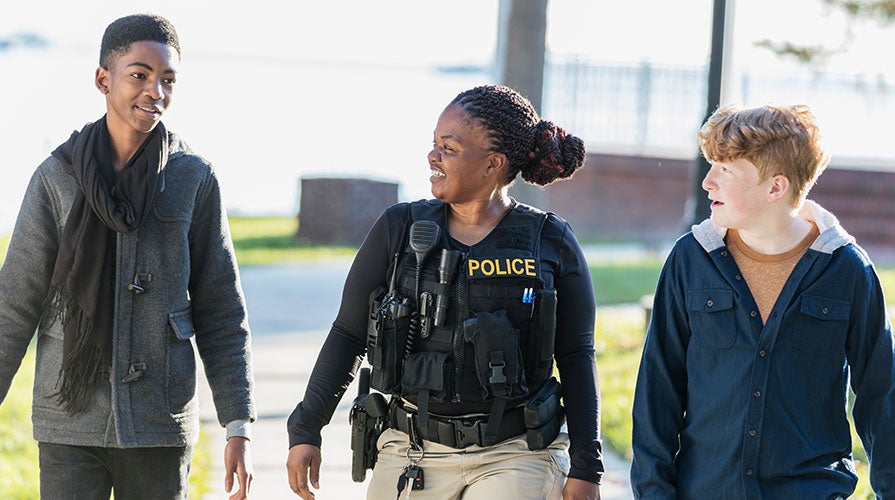
“I’ve got a granddaughter who was enrolled in pre-K this year for the first time,” said Stacy, whose North Texas district serves about 3,900 students. “Occasionally I would go up for a function at the school for her and I would see the officer and his interaction there, and it’s really cool to see how he takes ownership of that campus and kind of adopts these kids as his own.”
At a time when budgets are stretched, making difficult decisions on how to meet security needs is not easy. But school districts are learning that while the security and safety of Texas’ students and staff is the primary focus of on-campus law enforcement, there are other considerations.
The enhanced relationships between officers and students, staff, and the community are validating district decisions to create their own police department in ways that go beyond security.
“We’re here to support our children. We’re invested in our community, and we’re invested in our student population,” said Beeville ISD Police Chief Art Gamez. “Kids know they can come to us anytime they want. Some of the success stories we see because students know that we’re here for them are really special.”
Making the Big Decision
Beeville ISD dove into the school security discussion soon after the tragic 2018 shooting at Santa Fe High School in Southeast Texas, taking what Gamez called a very proactive approach.
“A lot of school districts were looking at what to do to better protect our children,” Gamez said. “Our school board asked if it was possible for us to create our own police department. What are the benefits and what are the pros and what are the cons of doing that? And then of course, what is the financial burden behind it?”
The Beeville ISD board ultimately voted to move forward and create a police department for the district, which is located about 60 miles north of Corpus Christi and serves nearly 3,000 students. Gamez, who previously worked for the Beeville police department, was hired to head the district’s new initiative in 2018.
Eight years later, Gamez is leading an 11-officer department and helping other districts through the same decision-making process. Earlier this year, Beeville ISD was among five member school districts selected by the TASB Risk Management Fund as recipients of the prestigious Excellence Award for 2026. Beeville ISD was chosen for a communitywide emergency drill simulation program that positioned the district to better respond to emergencies and strengthened trust with the community.
The first thing Gamez asks a district exploring its options is what it wants from its on-campus security. There are many options for meeting the state’s legislative requirements, but what a district wants beyond that is where the evaluation of a police department versus other solutions is made.
Weighing the Options
When districts are deciding between establishing their own department or using school resource officers, that debate often focuses on the existing relationship with public safety officials providing the resource officers, availability of officers, and reliability of the program.
Another issue is control. With school-based law enforcement partnerships, training and policies are determined by the agency contracted by the district, though school leaders naturally will discuss goals and concerns with the agency. Establishing a police department, however, does give the district full control.

Lake Dallas Police Officer Dave Contreras smiles for a selfie with Lake Dallas High School students at Buc-ee’s. Photo courtesy of Lake Dallas ISD
“If you have your officers in house, you write the policies,” said Andy Michael, the school safety and security consultant with TASB Risk Management Services whose long career in law enforcement includes serving as chief of police and director of security at Lake Travis ISD. “Everybody is working under policies that align with the district’s policies and goals.”
With SRO programs, school districts may have more limited resources to deploy outside of the regular school day for after-school events and through the summer months. Regardless, whichever direction a district decides to go, strong relationships and processes turn a law enforcement presence into a trusted school safety partner.
The geography of a school district can also be an important factor. Lake Dallas ISD had a contract for SROs, and great working relationships with their outside agencies, but the district boundaries fell within four municipal jurisdictions, with campuses in three of those cities. When the legislative mandate for armed security on every campus took effect in 2023, Lake Dallas ISD and its partner agencies felt the strain.
“The local governments were exceptional,” said Kristin Brown, Lake Dallas ISD superintendent. “They really tried their best to fill vacancies to make sure that we had the SROs at each campus. But there’s a shortage of police officers in the state of Texas. They were struggling to keep their vacancies filled and fill SRO positions that we had.”
As Lake Dallas ISD evaluated the situation in terms of logistics and goals, the discussion turned to considering its own department.

Police Sgt. Gordon Blair at Lake Dallas ISD’s Corinth Elementary enjoys fun ways to connect with students. Photo courtesy of Lake Dallas ISD
“We wanted the person that was there every day to have a strong relationship with kids,” Brown said. “We wanted kids to know who that person was, that they were there for their safety. [We wanted] kids to be able to call the officer and know where the officer was.”
Stacy, the board president, continued to have reservations. He was concerned about the additional liability the district would assume and the challenge of hiring the right people.
“School-based law enforcement is a different animal than regular policing. It takes a very special kind of person to want to do that job. It’s different when you’re in a school because you’re dealing with kids and you’re dealing with things that are way different than you normally do out on the street,” he said. “You have to be able to work with kids and then all of a sudden something goes really bad and you have to be able to flip that switch and go into that other mode that a lot of officers from a municipal standpoint are in all the time.”
Departments of All Sizes
Texas school district populations and geography vary greatly, creating a wide variety of challenges for addressing security needs and requirements. The 397 Texas districts with police departments range in size from small districts such as Sulphur Bluff ISD, with 195 students, to Cypress-Fairbanks ISD, with 114,697 students.
In the five years after the Santa Fe High School shooting, 139 new departments came online. Then in 2023, the Texas Legislature passed significant legislation making numerous changes to school safety laws. The changes include a requirement that at least one armed officer be present on each school district campus during regular school hours. For school districts unable to fully comply with this requirement due to a lack of funding or available personnel, the district’s board may annually claim a good cause exception that lays out an alternative standard with which the district is able to comply.
The new law prompted more discussions by districts about establishing their own police departments. Since then, 39 more districts have elected to create their own department.
“I really think it’s about the district’s commitment to making whatever program that they use the most successful they can,” Michael said. “If it’s an SRO program, you know, that starts with the superintendent and whoever on the school board is making those relationships with the police chief or the sheriff in that community. It’s a lot of factors, and I think a district really needs to look at everything.”
The Critical Hire
The recipe for success in building a police department seems to begin with one key ingredient.
“To me, it’s hiring the right person to lead that department,” Brown said.
When Lake Dallas ISD began searching for someone to lead its new department, the process was slow, something Stacy and Brown both admitted wasn’t easy. But finding the right mix of law enforcement background, an understanding of school policing, leadership, and administrative skills was something they wouldn’t compromise on. And there was one more critical skill they insisted on.
“It’s got to be somebody who knows how to communicate, knows all the ins and outs of the law enforcement side, knows all the ins and outs of the educational side, and can be that bridge between law enforcement and education,” Stacy said. “And Chief (Chadd) Springer is. It was just about being confident and being patient and just taking our time.”
Those skills are critical when a new chief needs to blend the law enforcement and education missions.
“This is a specialized type of policing, and you have to understand that,” Gamez said. “You have to understand how you bridge what a police department does traditionally to how a school functions and then service both areas while keeping the student at heart. That’s our main focus.”
Relationships Matter
School district police departments train to be prepared for the worst-case scenario. They have the same duties as officers with other agencies. But they also carry an increased responsibility to build relationships, and successful school district departments prioritize and cherish this role.
Those relationships can extend beyond the district.
“The community has really adopted us because we’ve been deliberate in getting out in the community and doing events and things that really don’t have anything to do with the school district,” said Springer, the police chief at Lake Dallas ISD. “We’re out there working with the municipal police departments.”
Springer noted that staff members participate in community events such as “Coffee with the Cops” and “Cones with the Cops.” Being part of these activities, he said, “puts us out there in the public and develops those relationships with the entire community.”
Within the district, student advisory committees in Lake Dallas ISD help shed light on how students connect with officers, something Brown said is very insightful.
“These kids know their officer’s name,” she said.
Connecting with students is Springer’s favorite part of the job.
“I’ve been working in the schools since 1999, and it’s just wonderful to see kids flourish,” he said. “They may have had some hiccups a few times while they’re there, but to see them understand that doesn’t define who they are is very rewarding.”
Officers’ daily contact with growing students is a shift from traditional policing roles.
“We work with these kids every single day, and there may be times we have to arrest a student because they’ve done something wrong,” Springer said. “But they’re coming back to school, and we get to continue to interact with them and help them develop and make them understand that, yes, they made a mistake, there are consequences for that, but that does not define who they are or define what kind of life they’re going to have. We have that ability to continue to work with that student, help that student, and work with the parents as well.”
Building relationships that include high-fives, laughs, and casual conversations serves officers in the core function of providing safety and security well before a potential tragedy even develops.
“We train so hard for that one day because that one moment, that one situation, can change the face of our school district forever, right?” Gamez said. “But just as important are all these other relationships we’re building. If I can prevent a tragedy before it gets to that point, I’d rather do that 10 times more. So, I think they’re equally important.”
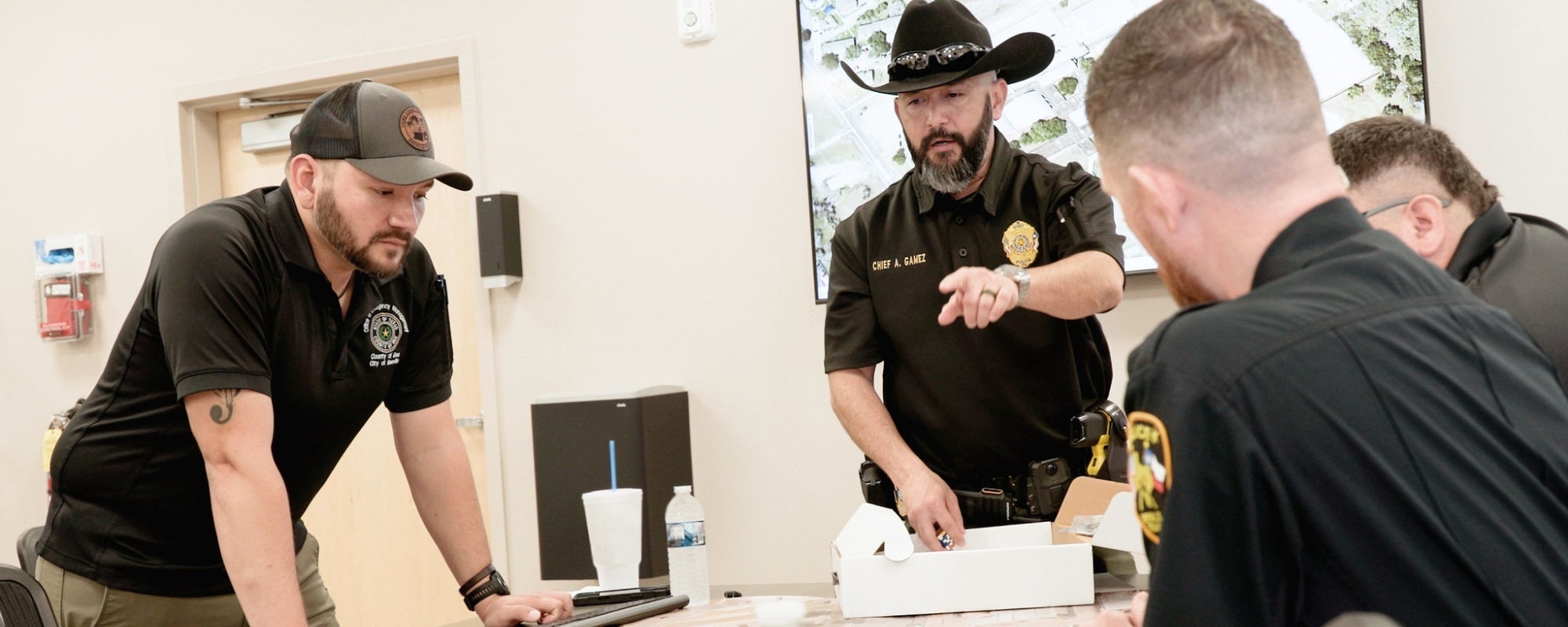
Photo: Beeville ISD Police Chief Art Gamez (in hat) conducts a table-top safety training exercise.
Photo by TASB Media Services
This article first appeared in the August/September issue of Texas Lone Star.
Mike Eddleman
Mike Eddleman is a senior communications specialist for TASB.