
Banding Together: Gregory-Portland ISD Board Governs by Design
For Tim Flinn, board president at Gregory-Portland ISD, when it comes to governance and the decision-making process, keeping the number one thing the number one thing, means that student achievement is always the primary focus for the district’s leadership team.
Flinn credits Superintendent Michelle Cavazos, who began her leadership role at the district in July 2020, with creating processes and dynamics that create a high-functioning team, ensuring her administrative team and the board of trustees each stay in their own lanes, while working collaboratively to meet goals.
But it wasn’t always that way, Flinn said. When he was first elected in 2015, he said there wasn’t really an official onboarding process in the South Texas district, which serves more than 5,000 students. As a result, he was uncertain what his role was as a trustee.
“If you don’t have a vision or mission statement, you do not have board operating procedures, or if you don’t have board norms, you’re just going from the hip, and you have no structure,” Flinn said. “The structure she’s allowed us to put into place is a strong structure. If I stepped down tomorrow, the board would not miss a thing; they would not flinch because we have all of those things in place.”

Showing they have a playful side, the leadership team from Gregory-Portland ISD poses as a rock band. All photos courtesy of Gregory-Portland ISD.
Building a high-functioning team that stays focused on its mission and vision doesn’t happen overnight or without effort, Flinn and Cavazos shared. Creating a collaborative culture requires action in and out of the boardroom. From Flinn’s and Cavazos’ standing breakfast meeting to scheduling meals with individual trustees and attending district events to incorporating special team-building workshops, the goal is to build a leadership team that stays focused on outcomes.
Cavazos and the trustees often make presentations at conferences, including TASB’s Summer Leadership Institute and txEDCON. That is intentional and another way the leadership team builds collaborative relationships, she said.
At SLI in June 2025, the leadership team presented a session titled “Keeping the Band Together,” which focused on how tuning up, practicing, and harmonizing is needed to make great music, and how those actions are similar to the work it takes to create a collaborative leadership team. Texas Lone Star spoke with Flinn and Cavazos about what boards and superintendents can do to maximize effectiveness, build relationships, and prepare for the board’s future. Their comments have been condensed and lightly edited.
When working to build a strong leadership team, is there a suggested starting point?
FLINN: Governance is such an important thing, but when you have a room with eight people who are all Type A personalities, you have to keep the focus on the number one thing, student achievement. Not on your agenda, not on your personal beliefs. That starts with good governance. It starts with really focusing on what is a trustee’s job and what is our lane.
CAVAZOS: Part of building the team is knowing what our strengths are, each of our quirks, and what drives us. That helps us navigate better situations and scenarios, and to know how to better support each other to be successful as a team.
What do you think are the key elements that go into creating a collaborative and productive team?
CAVAZOS: Tim mentioned governance, and we do governance workshops quarterly, which allow us in that time to really work on ourselves as a team. For example, one workshop we did recently related to trust within the team. We consider what are some things that can derail a governance team in working in the strategic lane. We try and talk through situations before they arise.
FLINN: It takes mature individuals to be able to sit and discuss and have a difference of opinions. Governance is huge, but when we look at our board scorecard, we don’t all have to think alike; we don’t all have to vote alike. We know we can all disagree.
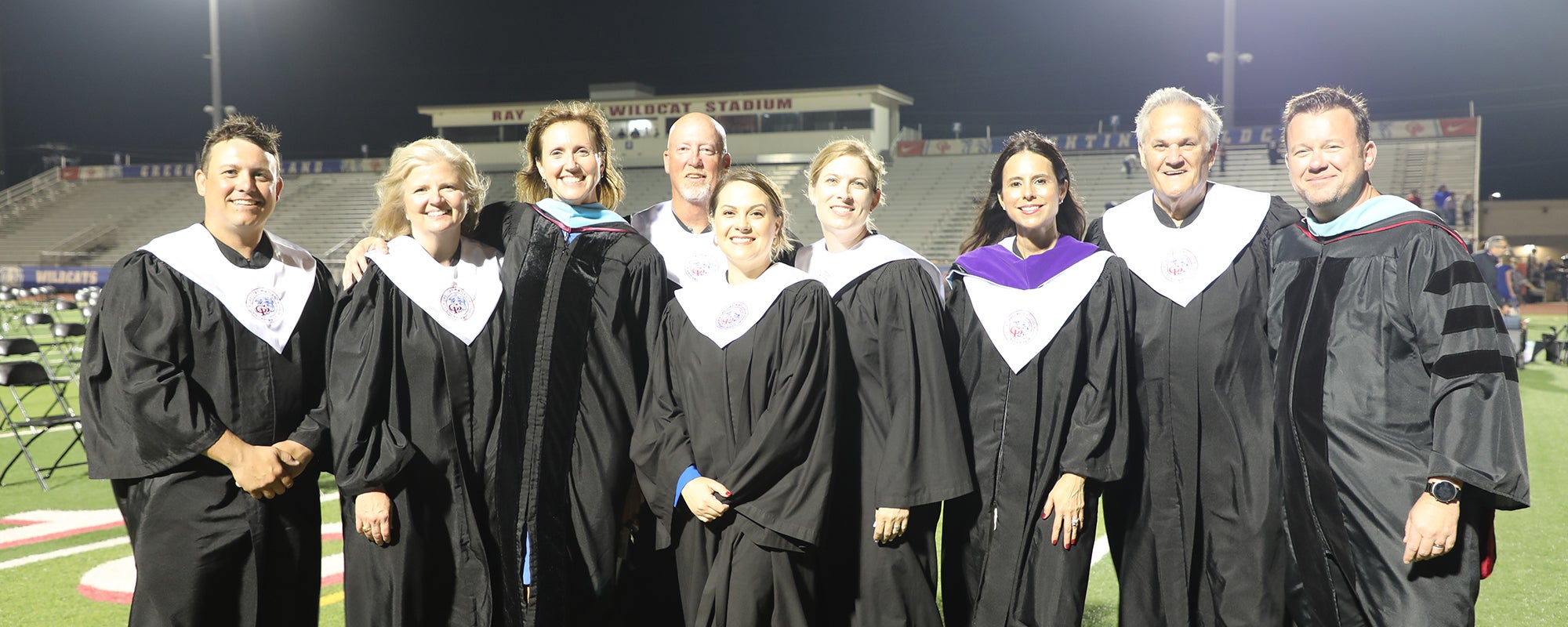
Members of the Gregory-Portland ISD board of trustees and district leadership, including superintendent Michelle Cavazos, gathered for a graduation ceremony.
What role does the district’s mission (and mission statement) play in the work you are doing to create a strong team?
CAVAZOS: Mr. Flinn mentioned that when we keep our focus on the students, that makes everything — or most things — fall into place. For example, we read our mission, vision, and beliefs at each board meeting, as well as at every meeting we have throughout our district. If there’s a decision and it doesn’t align with our mission, it’s an easy no or yes, depending on what it is. It keeps us very focused on our work.
FLINN: Our job is to allow her to lead, and all those things (the mission, vision, board norms) remind us about governance, who’s in charge, who runs things, who is the voice of the district. We have been blessed to have people who have servant hearts who are there for the right reason. And even though you are there for the right reason, if you don’t have that structure, if you don’t have that guidance, then you can get off the rails.
CAVAZOS: It’s a great marriage — so to speak — that allows us as the employees to do the work and allows the board to keep oversight of the work to make sure we are going in the direction that they’ve set to accomplish the goals they’ve set for us and for our students.
At your SLI session, you spoke about finding the right players for the board. How can a leadership team do this in a way that allows for openness and diversity of thought?
FLINN: When I’m out talking to people, I may know them and may not know them. I’ve been in sales management my whole career; I understand peoples’ characters. I don’t care if they are left, right, center. If they have a good heart and they are coming from that direction, I will push them in that direction — toward being on the board. I start coaching the next leaders. I’m out talking to people all the time.

The Gregory-Portland ISD board of trustees and superintendent Michelle Cavazos attend a groundbreaking ceremony.
CAVAZOS: Since I’ve been here, we’ve had several different district committees, and we’re very strategic about who we invite. And we have an open invitation to the community at the end of each year for people interested in being on committees. I ask our current trustees to name two or three people who they would have represent them on their behalf. There’s a lot of learning about the district through the different committees, such as what is our financial status or what do our academics look like. So, we are building capacity within community members or family members of our students who then could be potential future trustees.
How do you tune up over time? What are some key things you do as a leadership team to ensure that you continue to work well together?
CAVAZOS: We do quarterly governance workshops. We do an annual self-evaluation and review where we are with our trust with each other. And it leads to conversations that are more vulnerable than just about the work. It lets us work on the team.
FLINN: And we have our clear communication matrix that Dr. Cavazos brought to the district. That is a huge tool for us. If one board member asks a question, it gets put into that matrix and that way every board member knows the answer to that question, and it’s not just answered to that one board member. Keeping that open line of communication is huge.
One thing about our board, we always have an open line to the superintendent. In other words, you don’t have to go through the board president to ask the superintendent a question; it’s nice if you copy me, but you don’t have to go through me. She’s built really strong relationships with the seven board members to the point where they are calling to ask advice about other things. We’ve developed this relationship. This team is stronger — we don’t have a weak link.
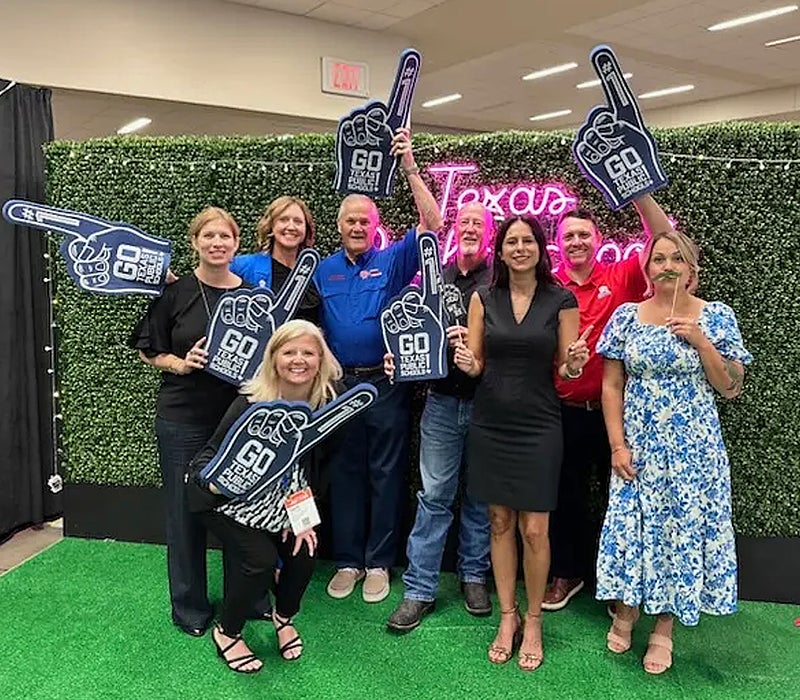
To build collaboration, the leadership team often presents at conferences such as txEDCON, which was held last year in Houston.
What steps do you take to build trust and connection as a team?
CAVAZOS: I work really hard so that my board isn’t blindsided by good, bad, or ugly information. And they’ve learned that sometimes things happen really fast, so maybe I’m not able to get the information to them, but they have learned to say, ‘The district has it under control, thank you so much.’ I guess I call it feeding forward; we have other mechanisms to let them know what is going on. They have talking points and points of pride, so they can talk about it with community members. It empowers them.
Trust is built by small daily actions over time. Yes, someday there may be something bad that happens at our district, but hopefully we’ve made enough deposits with our board and our community so that they know, ‘Hey, this is a one off.’ And we continue to have that trust and build that trust over time.
What else should readers know about your knowledge and understanding of leading by example?
CAVAZOS: A great team doesn’t happen by accident. It’s not a one-time event; it is something worked on daily and with great intentionality. When a team is willing and puts in the work, they can be unstoppable for kids and for the organization as a whole.
FLINN: One thing that I’ve tried to do in probably the last 12-18 months, when I talk to people, is to try to explain to them the difference between a trustee and a representative. When you are elected to the board of trustees, you are not there to represent. You are there — you are trusted to do what is right by the students, the staff, and the taxpayers. It’s not a group over here that has a loud voice. You’re trusted to do what is right by the students, staff, and the taxpayers.
This article first appeared in the Feb/Mar 2026 issue of Texas Lone Star.
Mary Ann Lopez
Mary Ann Lopez is a senior communications specialist for TASB.
