Flying High: Cleveland ISD CTE Students Take to the Skies
While it might seem that flying a plane is as easy as setting a straight course toward a destination, students in Cleveland ISD’s Aviation Tango Flight Aerospace and Engineering program know such thinking could lead to sticky situations.
“We have to calculate ground speed; we have to calculate air speed; we have to calculate for magnetic deviation,” said Cleveland High School senior Maria Garcia, an inventory manager for the program. “We have to calculate everything that provides us with a safe and secure flight.”
Cleveland ISD is located about 50 miles northeast of Houston and has about 12,711 students enrolled. The program’s students have the chance to earn a commercial drone license, a private pilot certificate, credit toward the general test required to earn an airframe and powerplant license, and possibly most impressive — to build not one, but two airplanes. They take the math and science learned in the classroom and apply it to real-world situations.
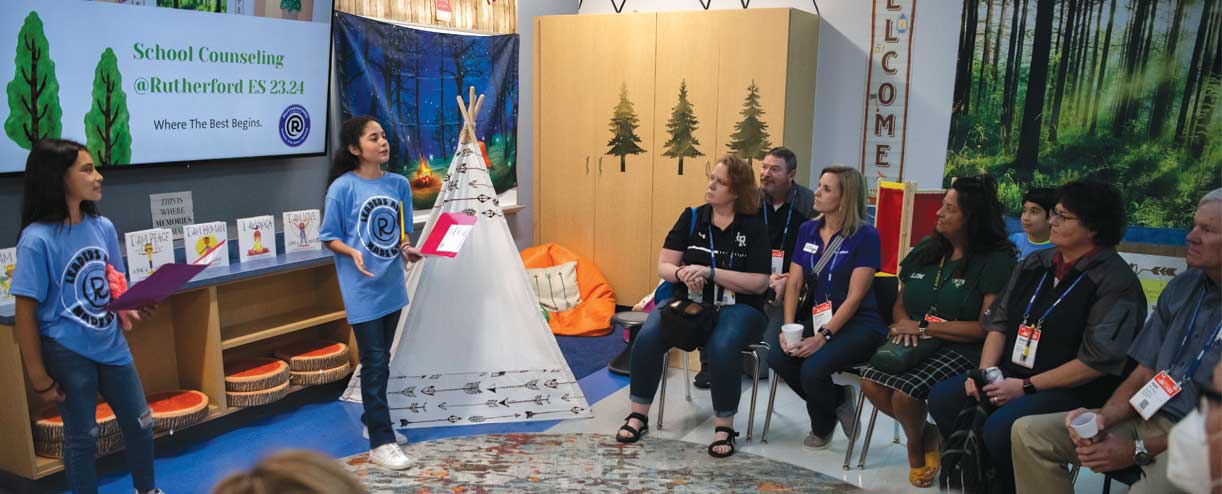
Cleveland ISD’s CTE Aviation and Engineering students shared their experience in March at TASB’s Governance Camp in Galveston.
As freshmen, students learn the basics of aviation, and they are exposed to the different career pathways available to them, Garcia said. As sophomores, they work toward their Part 107 Civil License — a commercial drone license that allows students to use their skills through drone work, which means they can earn money and be exposed to career opportunities. Students learn about the different types of drones and see the complexities, so they better understand the field, she said. They also learn about drone mechanics, safety, and regulations.
Learning By Doing

To be a better drone pilot, students need to understand all aspects of flying drones, said senior Kevin Velasquez, the program manager.
“Yes, you can go buy one, and that’s fine,” he said. “But when you build your own drone it gives you a sort of connection, you give more passion to it, because it’s like, ‘I did that.’”
Once students have passed the test and have their drone license, they can move on to the private pilot ground school, Garcia said.
“We actually have an FAA-approved curriculum that our mentor teaches us, which allows us to get so many great aspects and get the first big step into what being a pilot is,” she said. “We learn aerodynamics; we learn instruments — what actually is there in a cockpit. And obviously when we teach our students, we also want to be able to tie it back to their core classes. Our study materials actually tie back a lot to science and math.”
The students have a chief flight instructor who comes to the school to mentor students, Velasquez said. The flight instructor, who teaches the students to fly for free, must sign off so that they can be issued a student license, which helps them with their flying.
“This gives our students a huge advantage in their pilot careers,” Garcia said.
“After students get their pilot license, they are allowed to use our flight simulators — our FAA certified flight simulators — that actually allows our students to fly and log hours toward their private pilot license.”
Using simulators takes away some of the real risks, while offering students access to a variety of scenarios that might be encountered in the air, Velasquez said.
“You know when you are up there anything can happen,” he said. “So, having a sim is a good way for kids [to learn], so once they actually go and get into the cockpit, they already have that knowledge of trying it in the sim.”
Velasquez is working toward his private pilot certificate and is expected to earn it in the summer.
“Most of us don’t come from a lot of resources,” Garcia said. “And to be able to have this at school, it really allows us to get the support and help we need. And having this allows us to get an advantage.”
Fun but Hard Work

Senior Josue Cardenas, assistant manager for the program, said that while the classes in general are fun, and flying drones and using a simulator are also exciting, at the end of the day, students have to do the work if they intend to pass and earn their private pilot certificate.
“In our classes, the tests we take are FAA exams, which are government-issued exams,” Cardenas said. “Now, these aren’t just simple ABC or 1+1=2 questions. These are real-world scenarios they put you in. And some of these questions are pretty hard to answer.”
Despite the challenges, the students in the program achieve higher pass rates than the national average, with students earning a 98% pass rate for their pilot certificate, as one example.
“In the last three years since we’ve started our aviation program, we have certified 500 commercial drone pilots,” Velasquez said. “Three years, 500 kids; the next generation of aviation.”
Brian Stafford, the aviation and engineering instructor at Cleveland ISD, said that for some students who might not normally come to school, the program inspires them to show up every day.
“I used to coach football,” he said. “But for me, this has been probably the most rewarding program I’ve taught in my 15 years in education. And it’s nice to be able to teach something with a real-world application that you can see them applying as they graduate and leave. To be able to get them the different licenses and then watch them go out and make money, that’s pretty cool.”
The engineering, pilot, and mechanics programs converge at the end, coming together in a practicum course taken by juniors and seniors, Velasquez said. The practicum is a two-block class that students can take for two years.
“In our class, through our [district’s] partnership with Tango Flight, we are given the resources and the curriculum needed to build a plane,” Velasquez said. “That’s what we do. We build a plane.”
Tango Flight is a two-year aviation/aerospace-based program created to inspire the next generation of engineers, pilots, aviation mechanics and technicians, and flight crews.
“This is an opportunity that only about 60-something schools in the entire nation are able to do,” Velasquez said. “And I think there are around 10 [schools] in the entire state of Texas. So, it’s something that we were very proud of that we were able to do.”
Velasquez said the first plane the students built took about two years to finish, which was a big milestone because no other schools have been able to finish that quickly.
“No school has been able to do that apart from a school that was taught by the owner and founder of Tango Flight,” he said. “And then, with our current plane, we are going to finish it in one year. That has not been seen before and it’s something that we are really proud of.”
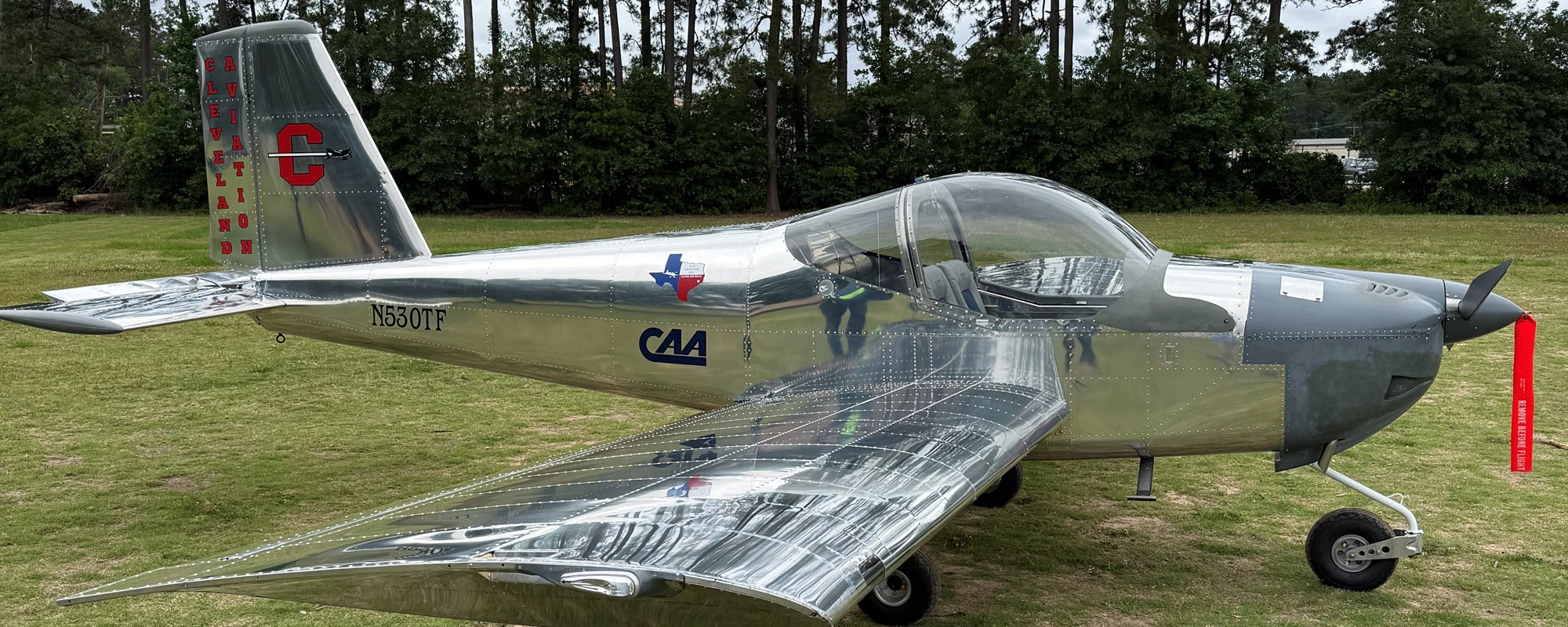
Students from Cleveland ISD’s Aviation Tango Flight Aerospace and Engineering program apply the math and science learned in classes to real-world situations encountered when building and flying airplanes. The program’s three tracks — engineering, pilot, and aviation mechanics and technicians — converge in a practicum course taken by juniors and seniors that requires them to build an airplane. The students have built two planes.
Photos courtesy of Cleveland ISD.
This article first appeared in the June/July 2026 issue of Texas Lone Star.

Texas Lone Star Magazine
Enjoy this story? Find other impactful public education stories in Texas Lone Star, TASB's flagship publication. Browse the latest issue and multi-year archive.
Mary Ann Lopez
Mary Ann Lopez is a senior communications specialist for TASB.